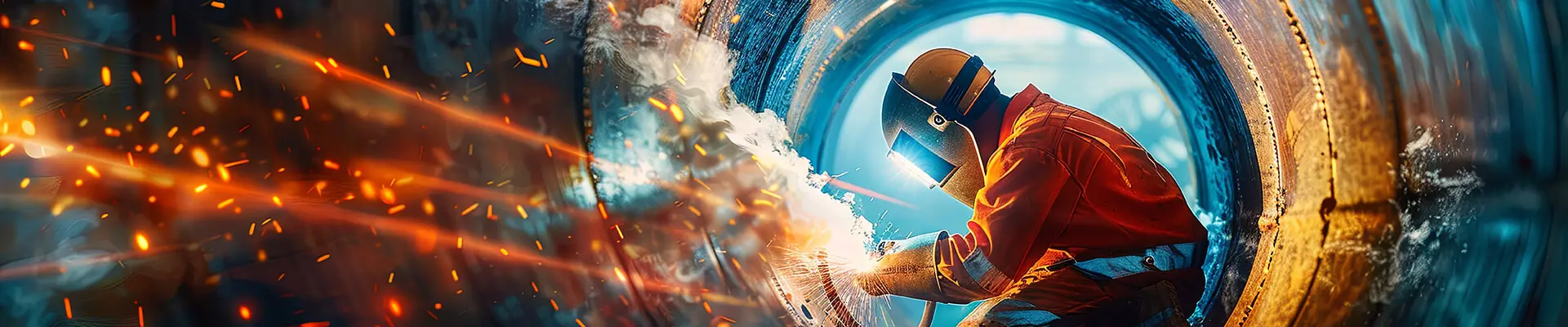
A welder in protective clothing and protective mask is welding inside a large pipe and sparks fly through the air.
The key to a safe construction

Not even the best welder can succeed with the wrong conditions

Welding and brazing services

– Focus on quality and safety

DEKRA is a leading provider of welding and brazing services, offering comprehensive solutions to ensure that structures and products comply with applicable standards and quality requirements.

With our expertise in welding procedures, personnel certification, non-destructive testing (NDT), and destructive testing, we help companies across various industries achieve safe and durable welded and brazed joints.

Our welding and brazing services

Welding procedure qualification

To ensure that a welding or brazing procedure meets the requirements of applicable standards, such as the SS-EN ISO 15614 series for welding and SS-EN 13134 for brazing, we conduct welding procedure qualification (WPQR and BPQR).
We assist manufacturers in preparing preliminary welding procedure specifications (pWPS), qualifying welding procedures according to standard requirements, and developing welding procedure specifications (WPS) in accordance with the ISO 15609 series based on qualified procedures. A properly executed welding procedure qualification is a fundamental part of safe and quality-assured production.

Personnel certification in welding and brazing

We certify welders according to the ISO 9606 series, operators according to EN 14732, and brazers according to ISO 13585. Our certifications ensure that personnel possess the necessary competence and skills to work in accordance with established quality standards.

Non-destructive testing (NDT)

Our inspectors perform non-destructive testing (NDT) to identify potential defects in welded and brazed structures without compromising the integrity of the components. We offer methods such as:
  • Visual testing (VT)
  • Radiographic testing (RT)
  • Ultrasonic testing (UT)
  • Magnetic particle testing (MT)
  • Penetrant testing (PT)
  • And many other testing methods

Destructive testing – laboratories for advanced analysis

DEKRA operates multiple destructive testing laboratories capable of handling most test setups within welding and brazing. We offer mechanical testing, metallographic examinations, and chemical analyses to ensure that materials and welded joints meet the required standards. Additionally, DEKRA conducts failure investigations, damage analyses, and condition assessments.

Quality manual according to ISO 3834 and EN 1090

To support our customers in meeting quality requirements in welding and brazing, we provide assistance in developing a quality manual in accordance with ISO 3834 and EN 1090. A quality manual serves as a comprehensive documentation of manufacturing processes, control points, and quality requirements, ensuring traceability and compliance with current regulations. We help companies structure and document their workflows to easily meet regulatory and customer requirements.

Inspection and control of welded and brazed structures

We perform inspections of welded and brazed structures according to ISO 3834 and EN 1090-2. Our inspectors ensure that manufacturing follows the correct procedures and that documentation is complete. We also assist companies in implementing and maintaining quality management systems.

Consulting and training

In addition to inspection and certification, we offer consulting and training in welding, brazing, material selection, and other technical matters. Our courses help companies enhance their expertise and ensure compliance with industry best practices.

Ensuring quality in your welding, from test welding to an approved welding procedure.

The creation of a WPQR (Welding Procedure Qualification Record) begins with performing a test weld based on the preliminary welding procedure (pWPS). After the test weld, both non-destructive and destructive testing are conducted to evaluate the weld quality.
Once the test results are approved, they are reviewed to establish the procedure's qualification range according to relevant standards. This includes parameters such as material groups, thickness ranges, welding methods, and welding positions. The qualification range specifies the conditions under which the procedure can be applied in production.
When the WPQR is approved, a WPS (Welding Procedure Specification) can be developed. The WPS is an operational document that describes exactly how welding should be performed in production, based on the parameters established in the WPQR. It serves as a practical guide for welders and ensures that each weld is executed with consistent quality and in accordance with qualified procedures.
Welding procedure qualification is a fundamental part of quality assurance in welding processes. It ensures that manufacturers can produce weld joints with the required quality and strength. The purpose is to verify that the welding procedure is reliable and can be used in production without compromising safety or durability. A procedure qualification is a report that confirms whether the welding meets the requirements for the material and the welded joint.

Why is Welding Procedure Qualification necessary?

Procedure qualification is not only a quality measure but often a legal requirement depending on the application and industry. It ensures that welded structures comply with safety standards and reduces the risk of failures. For example, procedure qualification is required under the Pressure Equipment Directive (PED) for pressure-containing equipment and according to SS-EN 1090 for load-bearing steel structures. Additionally, some customer-specific standards and project requirements mandate procedure qualification to meet contractual quality requirements.

How to determine which Welding Procedure Qualifications are needed?

The choice of welding procedure qualifications depends on several key factors that together form a comprehensive understanding of the requirements for the specific manufacturing process:
  • Type of construction: The type of qualification required is highly dependent on what is being manufactured. Structures such as tanks, piping systems, bridges, building frameworks, and pressure vessels often have different load conditions and safety requirements. For example, pressure-containing equipment requires rigorous control and multiple qualifications compared to a simple bicycle rack made from a single material.
  • Material: Different materials have different weldability characteristics. Steel, aluminum, copper, titanium, and nickel-based alloys react differently to heat cycles and mechanical stress. Each material group requires specific procedure qualifications to ensure that the weld achieves the desired mechanical properties.
  • Load conditions: The intended use of the structure and its exposure to dynamic loads, pressure, temperature variations, and corrosive environments affect the choice of procedure qualification. High temperatures, for instance, can alter the strength of the weld, necessitating specific tests to verify weld quality.
  • Regulatory requirements: National and international laws, as well as industry-specific standards, often mandate procedure qualifications. For example, the construction industry requires certification according to EN 1090, while offshore and petrochemical industries may require qualification according to NORSOK standards or ASME codes.
In summary, the need for welding procedure qualification is determined by analyzing the specific manufacturing requirements, material properties, product application, and applicable laws and standards. This comprehensive assessment ensures that the selected procedures produce a safe, durable product that meets all relevant regulations.

Welding Procedure Qualification – we support you every step of the way

Would you like to learn more about the welding procedure qualification process? In DEKRA’s guide "From Procedure Qualification to Production – the path from WPQR to WPS", you will find a clear and detailed description of the process.
Do not hesitate to contact us if you have any questions or need assistance in qualifying your welding processes. DEKRA is an expert in the field and operates across Sweden. We are ready to support you throughout the entire qualification process – from planning to final procedure qualification.
The most common Welding Procedure Qualifications
Welding
– Arc Stud Welding of Metallic Materials (ISO 14555)
Specification and Qualification of Welding Procedures for Metallic Materials
– Qualification Based on Pre-Production Welding Test (ISO 15613)
Specification and Qualification of Welding Procedures for Metallic Materials
– Welding Procedure Test – Part 1: Arc and Gas Welding of Steels and Arc Welding of Nickel and Nickel Alloys (ISO 15614-1)
Specification and Qualification of Welding Procedures for Metallic Materials
– Welding Procedure Test – Part 2: Arc Welding of Aluminum and its Alloys (ISO 15614-2)
Specification and Qualification of Welding Procedures for Metallic Materials
– Welding Procedure Test – Part 3: Fusion and Pressure Welding of Unalloyed and Low-Alloy Cast Iron (ISO 15614-3)
Specification and Qualification of Welding Procedures for Metallic Materials
– Welding Procedure Test – Part 4: Full Welding of Aluminum Castings (ISO 15614-4)
Specification and Qualification of Welding Procedures for Metallic Materials
– Welding Procedure Test – Part 5: Arc Welding of Titanium, Zirconium, and Their Alloys (ISO 15614-5)
Specification and Qualification of Welding Procedures for Metallic Materials
– Welding Procedure Test – Part 6: Arc and Gas Welding of Copper and its Alloys (ISO 15614-6)
Specification and Qualification of Welding Procedures for Metallic Materials
– Welding Procedure Test – Part 7: Overlay Welding (ISO 15614-7)
Specification and Qualification of Welding Procedures for Metallic Materials
– Welding Procedure Test – Part 8: Tube-to-Tube Sheet Welding (ISO 15614-8)
Specification and Qualification of Welding Procedures for Metallic Materials
– Welding Procedure Test – Part 11: Electron Beam and Laser Welding (ISO 15614-11)
Specification and Qualification of Welding Procedures for Metallic Materials
– Welding Procedure Test – Part 12: Resistance Spot, Seam, and Projection Welding (ISO 15614-12)
Downloads:
Contact

For safer facilities and more efficient decision-making.

Heat, corrosion, mechanical stress, and wear alter a material's properties throughout its lifecycle. Making the right decisions regarding refurbishment, new investments, or continued operation requires both reliable data and in-depth knowledge of processes, materials, and corrosion risks. DEKRA offers comprehensive support in materials technology and failure investigation, ranging from basic metallurgical analyses and condition assessments to more complex failure investigations.

Advanced laboratories for in-depth material analysis

DEKRA has a network of nine European laboratories equipped with modern technology to perform everything from microscopy and replica testing to advanced strength and corrosion analyses. Our specialists combine extensive experience with state-of-the-art equipment to identify and prevent potential failure risks. We can quickly analyze samples in our labs, but we also conduct on-site assessments when needed.

Our laboratories offer, among other things:

  • Detailed metallographic examination to detect cracks and microstructural changes that could lead to failures.
  • Corrosion and chemical analyses to assess the material's resistance to various environments.
  • Mechanical testing and strength calculations to evaluate how a material or weld joint behaves under different loads and temperatures.
  • On-site replica testing, allowing surface impressions to be taken to identify damage or changes without cutting out a sample.

Our services and areas of expertise

1. Metallurgy and replica evaluation
A fundamental metallurgical analysis determines whether a material can continue to be used or should be replaced. When needed, we perform on-site replica testing or bring samples to the lab for a more comprehensive examination.
2. Condition and lifecycle analysis
Using corrosion and material expertise, strength calculations, and various testing methods, we assess the remaining service life of components.
3. Failure investigation
If damage or failure occurs, we determine the root cause and recommend corrective actions to prevent recurrence. Our approach combines laboratory analyses with extensive expertise in materials technology.
4. Stress analysis
We conduct both static and dynamic analyses to detect risks early, optimize maintenance, and extend the facility’s lifespan.
5. Material selection and materials technology
Assessing factors such as weld quality or how a structure behaves at high temperatures requires advanced material analyses. Our laboratories serve as an invaluable resource for ensuring accurate and reliable results.
6. Corrosion analysis
Corrosion can arise from various factors, such as incorrect material selection, deprived workmanship, or an unfavorable environment. We identify the root cause and provide recommendations to prevent future issues.

How you benefit from DEKRA’s services

  • More confident decision-making
    Reliable data helps you determine whether to continue operations, perform repairs, or make new investments.
  • Prevent unexpected downtime
    Regular analyses and inspections allow you to detect critical changes in time.
  • Long-term solutions
    With our combined expertise in materials technology and failure investigation, we provide action plans that support safe and economically sustainable operations.
Contact

Why “SS-EN ISO 3834” and a well-developed quality manual?

The SS-EN ISO 3834 standard series describes how quality assurance for welding can be achieved. Being certified according to this standard provides many benefits, including increased trust, clear procedures, and reduced risk of errors. However, even if full certification is not pursued, establishing order and structure through a functional quality system offers significant advantages.
A quality manual becomes a key tool in this process, compiling procedures, descriptions, and documentation that demonstrate how the company meets the standard requirements.
The ”ISO 3834” quality system includes:
  • Requirement review.
  • Technical review.
  • Qualification of welders and welding procedures.
  • Traceability of base materials and filler materials.
  • Inspection and testing before, during, and after welding.
  • Handling of deviations and preventive actions.
  • Requirements for maintenance and calibration of equipment.
By implementing a clear and well-documented system, the risk of errors and production interruptions is reduced. At the same time, customer confidence increases, and a foundation for continuous improvement is established.

Common questions in welding companies:

  • How should a procedure be structured to ensure correct execution?
  • How are materials correctly used and controlled throughout the process?
  • How is the welding process managed and monitored?
  • Is the inspection of welds properly carried out and documented?

DEKRA’s method for establishing a functional quality system

1. Analysis of existing processes
DEKRA begins the collaboration with a current state analysis. We examine how your welding operations are conducted, what procedures exist, and where they may fall short of ISO 3834 requirements. This can include everything from welder competence and procedures to documentation of material traceability.
2. Defining requirements and ambitions
Depending on customer or industry requirements, you and our experts determine which level of ISO 3834 is needed (more on this in the table below). Additional standards or regulations that may impact the design of your quality system are also clarified.
3. Development of the quality manual
Once the requirements are established, we compile a quality manual, which serves as a comprehensive control document, including:
  • Welding procedure routines: Clear instructions for welding operations.
  • Material handling: Purchasing, receiving inspection, storage, and traceability.
  • Parameters and inspections: Applicable parameters for different products, deviation handling, and documentation storage.
  • Inspection and testing: Including non-destructive testing (NDT), visual inspections, and dimensional testing.
4. Implementation and training
A quality system is only as effective as the people who apply it. DEKRA offers training and workshops to ensure that the entire organization understands and follows the updated routines. This includes both theoretical knowledge of standards and practical application in your production.
5. Continuous follow-up
Once the quality manual is in place, we assist with monitoring its effectiveness through internal audits and regular inspections. This ensures that your quality system remains a dynamic tool that evolves and adapts to changes in the business.
No.ItemISO 3834-2ISO 3834-3ISO 3834-4
1Requirement reviewRequired, documentedMay be required, documentedNo specific documentation required
2Technical reviewRequired, documentedMay be required, documentedNo specific documentation required
3SubcontractingSupplier must meet equivalent requirements; responsibility remains with the manufacturerSame as ISO 3834-2Same as ISO 3834-2
4Welder qualificationRequired (formal qualification necessary)RequiredNo specific requirements
5Welding supervision personnelRequiredRequiredNo specific requirements
6Inspection and testing personnelRequired (qualification according to standards)RequiredNo specific requirements
7Equipment for production and testingMust be appropriate and available as per requirementsSame as ISO 3834-2Same as ISO 3834-2
8Equipment maintenanceDocumented plans and maintenance requiredRecommended but not always mandatoryNo specific requirements
9Equipment descriptionList requiredNo specific requirementsNo specific requirements
10Production planningPlanning and documentation requiredRecommendedNo specific requirements
11Welding procedure specifications (WPS)RequiredRecommendedNo specific requirements
12Qualification of welding proceduresRequiredRecommendedNo specific requirements
13Testing of filler material batchesIf required by specificationNo specific requirementsNo specific requirements
14Storage/handling of filler materialAccording to supplier recommendationsAccording to supplier recommendationsNo specific requirements
15Storage of base materialProtection against environmental impact, identity maintainedNo specific requirementsNo specific requirements
16Post-weld heat treatmentProcedure, records, and traceability required (if required in product standard)Procedure and records requiredNo specific requirements
17Inspection and testingRequiredIf requiredNo specific requirements
18Deviations & corrective actionsMeasures to control deviations, repair procedure requiredMeasures implementedNo specific requirements
19Calibration/validation of measuring & inspection equipmentRequiredIf requiredNo specific requirements
20Process identificationIf requiredNo specific requirementsNo specific requirements
21TraceabilityIf requiredNo specific requirementsNo specific requirements
22Quality reportsIf requiredIf requiredNo specific requirements
Note: This table is a simplified version of Annex A in SS-EN ISO 3834-1:2021 (Swedish). For practical application, it is important to follow the full standard and adapt it to company-specific needs.

How DEKRA supports you in choosing the right level

Determining the appropriate ISO 3834 level (2, 3, or 4) can be challenging.
DEKRA assists you with:
1. Analyzing requirements
  • What are your customer or industry requirements?
  • How complex and critical are your welded products?
2. Recommending the appropriate level
  • In some cases, a simpler system (e.g., ISO 3834-4) may be sufficient for internal and external requirements.
  • In other cases, the more comprehensive ISO 3834-2 is required, particularly for safety-critical products or those exported to markets with stringent formal requirements.
3. Practical adaptation of the quality manual
  • Avoid over- or under-implementing requirements.
  • Ensure efficient, accessible, and practical documentation.
Why choose DEKRA?
1. Extensive experience and a holistic approach
DEKRA works daily with welding companies of all sizes and industries. We understand both the theoretical ISO 3834 requirements and the practical conditions of production.
2. Comprehensive solutions
We assist not only with documentation but also with practical advice, training, and follow-up.
3. Global expertise – local support
As an independent and global organization, DEKRA has a strong international reputation while providing personalized and local support for your company.
4. Focus on long-term improvement
Our goal is to create a quality system that evolves and improves over time, rather than being a static “paper product.”

Summary and next steps

Implementing or improving a quality system according to SS-EN ISO 3834 leads to:
  • Clearer responsibility allocation in the welding process.
  • Increased safety and reduced risk of errors.
  • Greater trust from customers, authorities, and stakeholders.
  • More efficient production and reduced waste.
DEKRA provides expertise and support throughout the process – from initial analysis to full implementation and audits.Want to learn more? Contact us for a consultation on how we can help your company take control!
Contact

Why choose DEKRA?

With our extensive experience and international presence, DEKRA is a reliable partner for companies looking to ensure the highest quality in welding and brazing. We work closely with our clients to provide tailored solutions that meet their specific needs.
Whether you need certification, testing, or technical consulting, you can trust us to deliver expertise with a focus on safety and quality.
Contact us to learn more about how we can support your welding and brazing needs!
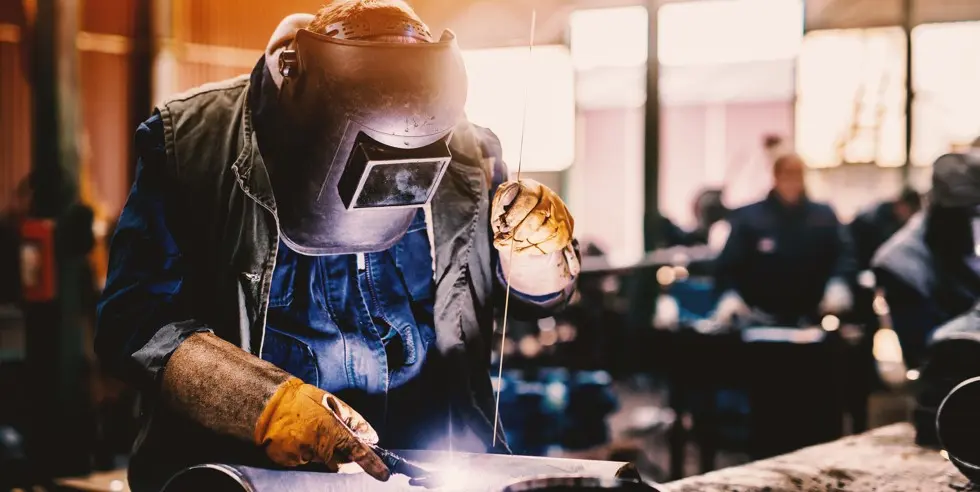
A welder with a safety helmet leaning over an object with the welder and sparks flying.
Meet DEKRA at Elmia Welding & Joining Technology 2026!
We are participating in Elmia Welding & Joining Technology in Jönköping on May 19–22, and would like to invite you to our booth. Come by and meet us at DEKRA, where we are happy to talk about standards, quality and future solutions in welding and joining. At the booth there is also the opportunity to compete with “real” rally cars on our car track – and of course we offer ice cream in good company. You will find us at booth A00:46. We look forward to meeting you at the fair!
Personal Certification Welding
Authorities, standards and customers can make demands that the welding work be carried out by certified welders. The certificates are personal and are obtained after an approved welding test. The certificates are valid for 2 or 3 years (depending on the standard) provided the welder can demonstrate that he/she maintains his/her competence.
The Welding Portal welDBase
The welDBase web portal is a welding database that gives you a quick overview of your welder, solderer and operator certifications. The welDBase program is available in both Swedish and English.
Svets
Welding courses
DEKRA trains over 10,000 people in safety annually. The importance of knowledge among those who handle the equipment must never be forgotten. We have knowledgeable, experienced and educational trainers and we also offer customized training.
Contact
Share page :